I made a post yesterday about losing one of my yearling does. I think I mentioned on my Facebook farm page (Van-Goght LaManchas), but not here, that I have seven chocolate brown 2025 LaMancha does who are carbon copies of one another. (Six now, I guess.) They’re a little (a lot!) hard to tell apart, and because of that, I thought, yesterday, I’d lost one of Cassandra’s daughters.
Cassandra is my oldest Natalie daughter, and Natalie is one of the only two remaining does in my herd who doesn’t carry the Van-Goght herd name. She was brought in as an improvement doe, and I’ve been hoarding her daughters and granddaughters like my husband is hoarding silver in the current economic and political climate.
It turns out I didn’t lose a Cassandra daughter; I lost one of Andromeda’s daughters. I don’t know if that makes it better or worse.
Andromeda gave me triplet daughters last year. I lost one shortly after birth. (Yet another chocolate brown one.) The doe I lost yesterday stood out from all the other chocolate does only because she had a white thumbprint on her side. (Of course I lost the only one with a distinguishing marking!)
If it’s any consolation (I guess it is to me), the doe I lost yesterday has joined her lost littermate sister. My brain is wired weird, and that gives me some sense of congruence and peace. I sobbed over that dead baby kid when I lost her, and I sobbed over her sister yesterday. I’m moving on today.
The surviving triplet sister is chamoisee, my favorite color. And I’d like to say, at least I can tell her apart from the rest of my goats, because she isn’t chocolate, but that isn’t exactly true either. I have an identically colored and marked chamoisee yearling doe with a completely different pedigree in the same pen. At least I can read their tattoos. 😆
The doe I lost was named Selene. Her sister is Calliope. Calliope will stay here and make her mark. Andromeda has gone on to a new herd, making these bloodlines all the more valuable here. Stay healthy, Calliope!
I said yesterday that my Dad had once told me I didn’t deserve to own animals. I imagine you’re wondering what I did, for him to say that to me. And the truth is, I don’t remember. I don’t even think it had anything to do with animals. It’s just…some people know how to find your weaknesses, and how to use them. Some people tell you things, and you believe them.
I remember the first time he said that. When I was seven, we had two goats, Nanny and Billy. They’re mentioned in one of my earliest posts. (And I do have a story to tell about Billy. I’ll get there one of these days, if I don’t abandon this entire project first.) Nanny had twins the first time she kidded, and one was stillborn. When the other was ready to wean, my parents found it a home. They didn’t tell me in advance. I had a baby goat, and then I didn’t.
I have a clear memory of laying on my stomach on my bed, sobbing, with the door closed, after my parents sold that goat. I was broken-hearted and distraught. Then my dad opened the door and yelled at me. He told me that that was a part of owning livestock, and if I couldn’t handle it, I didn’t deserve to own any. But nobody had told me at any point that they were selling the kid. I didn’t understand that was going to be the outcome. I felt betrayed. I was crushed.
Anyway, the message was–and I heard it over and over, over the years–if you cry over them, you shouldn’t have them.
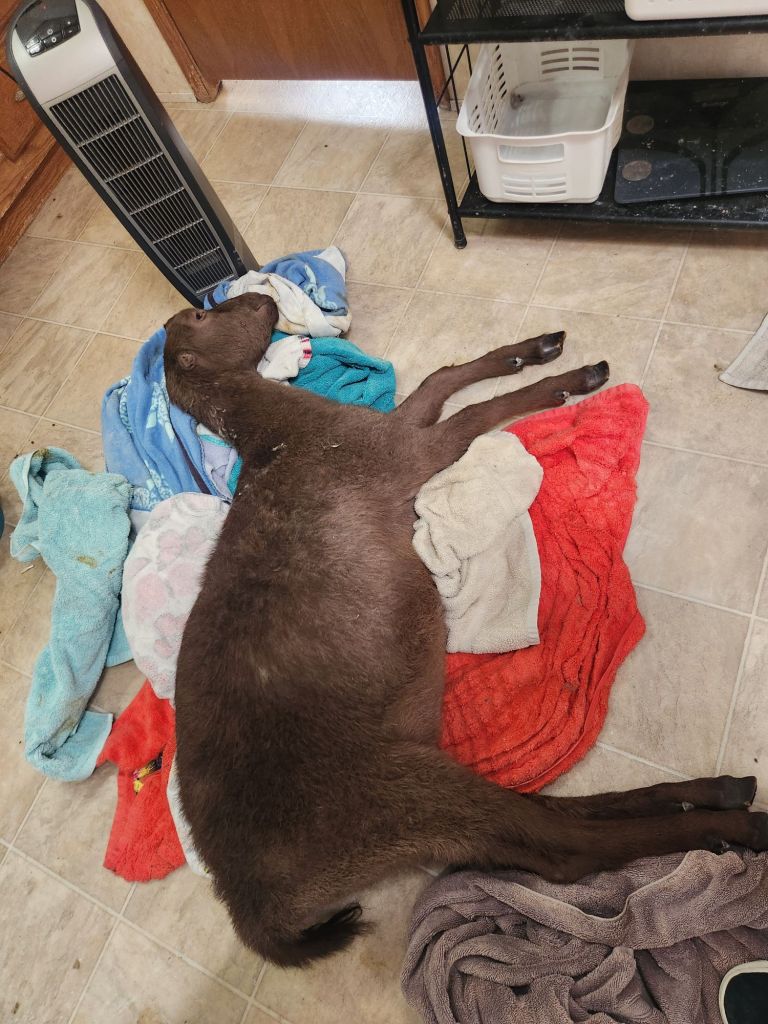
Today, I was going to go unpublish everything I’ve shared here. I was going to switch to some sort of photo-heavy, cutesy, baby goat blog that doesn’t make anyone uncomfortable…including me. But I ended up spending the morning trying to save a sick kid instead. A really d*mned good, nice coming yearling. The scrubby ones never get sick, I assure you. If your heart is involved, well…f*ck. This one really hurts.
We haven’t made any big changes of late, but Mother Nature did. We went from a ridiculously and uncharacteristically warm couple of winter months to subzero temps day and night, and it stressed some goats.
My oldest matriarch of a doe got sick first. She’s 11, pregnant, and a bit of a princess. When the temps dropped, she went off feed, changed her mind, bloated herself, and then got what I assume is secondary pneumonia, due to either the bloat or the treatment.
She surprised me by deciding to survive the works. She’s rebounded and is doing great. I guess this yearling is the sacrifice to the Gods that I owe for her survival.
The old doe, of course, is carrying three bucklings, mark my words. And of course she didn’t settle when I bred her to my first choice of bucks, so these aren’t even the kids I ordered. (It’s okay. Yes, I’ll keep one anyway. It wasn’t what I planned, but I try to roll with whatever the Universe hands me.)
Of course, your radar is better, your instincts are better, you’d’ve headed this off at the pass. Your pockets are deeper, and your vet knows how to bring back the near-dead. I hate putting these things out there, because the armchair quarterbacks wouldn’t have gotten it wrong. I got it wrong.
This sucks, I hate it, and I’m going to sit here and second-guess my choices and my actions and my place in the universe and the point of it all. I’m mad. This was a really good one.
I chose to write this and share this rather than deleting my blog today, because I saw a post on Facebook from someone who delivered triplets under challenging circumstances, and lost one.
She didn’t know what to do, she called the vet, she panicked, she gathered herself, she went back in and sorted the kids and got them out and saved her doe…and she collapsed in a puddle of tears over a big, dead buck kid who she didn’t get out in time.
You were brave and you did what you had to do. This is a normal part of owning and raising animals. You did good. I’m proud of you.
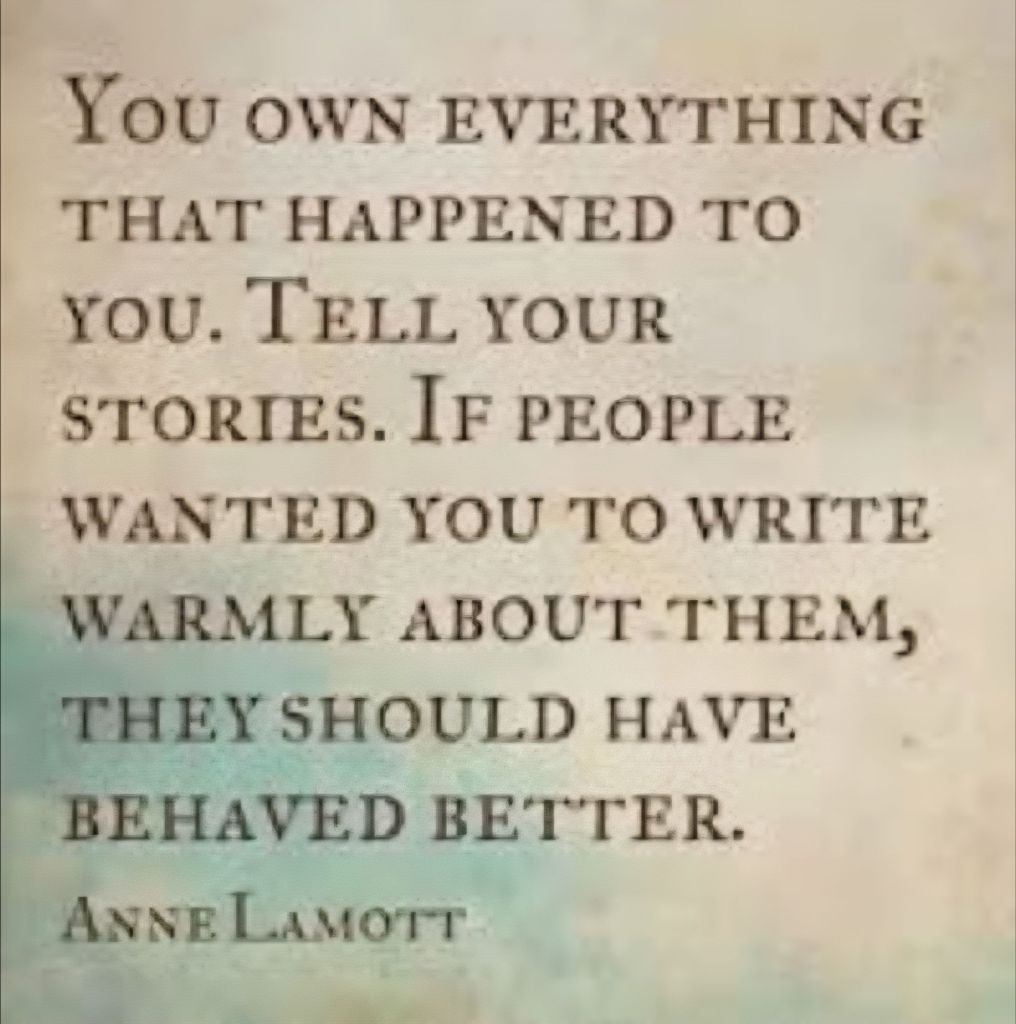
I spent my life breeding, delivering, raising animals. I like to think I mostly got it right. But one time, I did something to make my Dad mad, and he caught me as I was walking out of my house, looked me in the eye, and told me I didn’t deserve to own animals.
I have a dead goat on my bathroom floor. And I don’t know if I deserve to own animals.
Goat blog, or creative writing outlet? How about both.
I’m fascinated by all the people (or bots) screaming on-line that the Guthrie case is just a distraction from Epstein. Are you kidding me? This news coverage feels downright nostalgic. For one, we’re all so sick and tired of political drivel 24/7 that this feels almost wholesome, and for two, everybody I know listens to true crime podcasts. Anyone who habitually listens to true crime is eating this up. The other huge complaint on-line is whataboutism, “What about people who aren’t famous who go missing?” Oh, ffs. I’m not particularly interested in this case, but I do understand why it’s taking center stage. It’s mental bubble gum. Of course I feel bad for the family. But I don’t know the family, so it’s easy to hold it at arm’s length and work it like a puzzle.
There are a few typos, misspellings, missing letters, and words in the wrong order throughout. I was once a paid proofreader, so I have no excuse. But I also don’t know how to correct published pages, so… 🤷♀️ I am writing these on my phone, and I am so old I can’t see the screen, so. Deal with it, I guess?
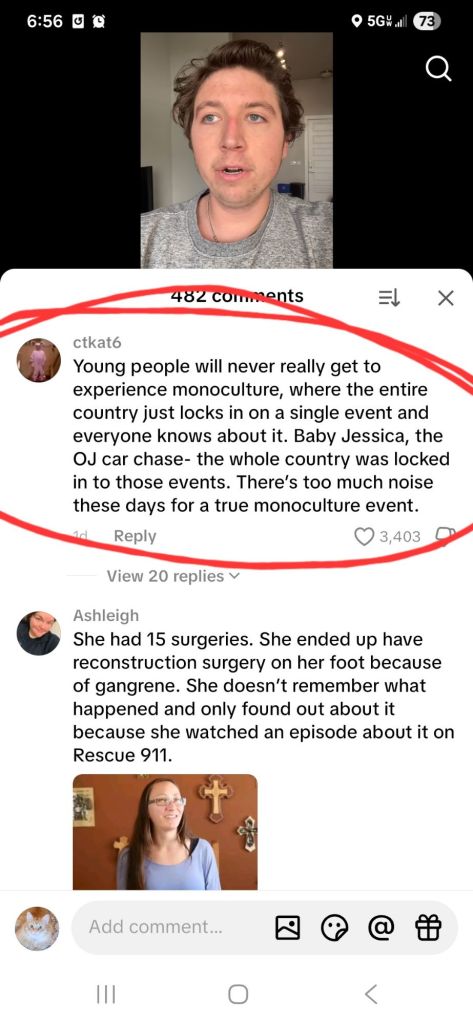
I’ve noticed something somewhat troubling on social media of late. Now that Facebook has monetized accounts, there is a whole lot of manufactured controversy popping up. Why? Because it sells. Or rather, garners clicks. Everybody can get paid for clicks.
Suddenly, everybody has to have an opinion. They can get paid for it! And the more obnoxious the opinion, the better. If there is a flurry of angry activity in the comment section, that’s engagement. Engagement pays.
This is digital evolution, and the related growing pains, and it’s okay. Everybody has to make a living, and as Scott Adams used to say, “Never leave free money on the table.”
Social media money is relatively easy money. But it’s lazy money. (Not always! Don’t come at me! It’s just that…often, it’s lazy. Lazy is saying the last, best triggering thing, and then jumping on every comment in the comment section. It is picking fights just to pick fights, to grow your page. Unfortunately, it works. It’s making the world an uglier place.)
The trouble with creating controversy for controversy’s sake just to provoke engagement is, it feeds further into our already broken social system. Pits people with the same interests against one another. Fractures people into smaller and smaller groups. Makes the real world less and less pleasant. Start calling it a job, and you can justify anything.
I’m not talking about politics (at least not the State and Federal kind), although the left vs. right divide has made a whole lot of folks a whole lot more comfortable aggressively taking sides and loudly setting hard boundaries in all walks of life…oftentimes to the detriment of all involved. I’m talking about mom-and-pop farms and hobby farms and rescue farms and horse breeders and goat breeders and so on and so forth.
There are a whole lot of bloviating, neatly ChatGPT-edited, posts circulating on every topic under the sun. Some farm pages are posting 10 and 12 times a day. I’m not saying it’s a bad thing, but it is a noticeable shift.
I suppose in time, the cream will rise to the top, and we’ll all gravitate to the few farm and livestock pages delivering the best content. It’s too much to hope for, but maybe instead we’ll all get so overwhelmed and bored with scrolling that we’ll set down our phones and go outside. But we’re evolving, and this how we feed our brains now.
I’ve resisted every opportunity to monetize anything on-line. I have a TikTok, but just to share Frank the cat videos. I don’t get paid for views. I encourage other people wholeheartedly to take advantage of the opportunities TikTok provides…don’t leave free money on the table. I just happen to have a face made for radio, and a personality that probably needs to be institutionalized. I don’t think my brand would sell anyway.
The appeal of a blog is, it feels a little old school, and I feel like very few people still have the bandwidth to read one. Our brains have been broken, and only 30-second video clips can really provide what they want. So in theory, I’m safe here, thinking my thoughts “out loud.” Nobody’s listening anyway.
I feel a little vulnerable having shared that story. Although, for all intents and purposes, I’m uncancellable, because I don’t need your approval and I don’t need your business. I’ve just been a participant in social media for too long. I know how it works. I shouldn’t be putting my words out into the world.
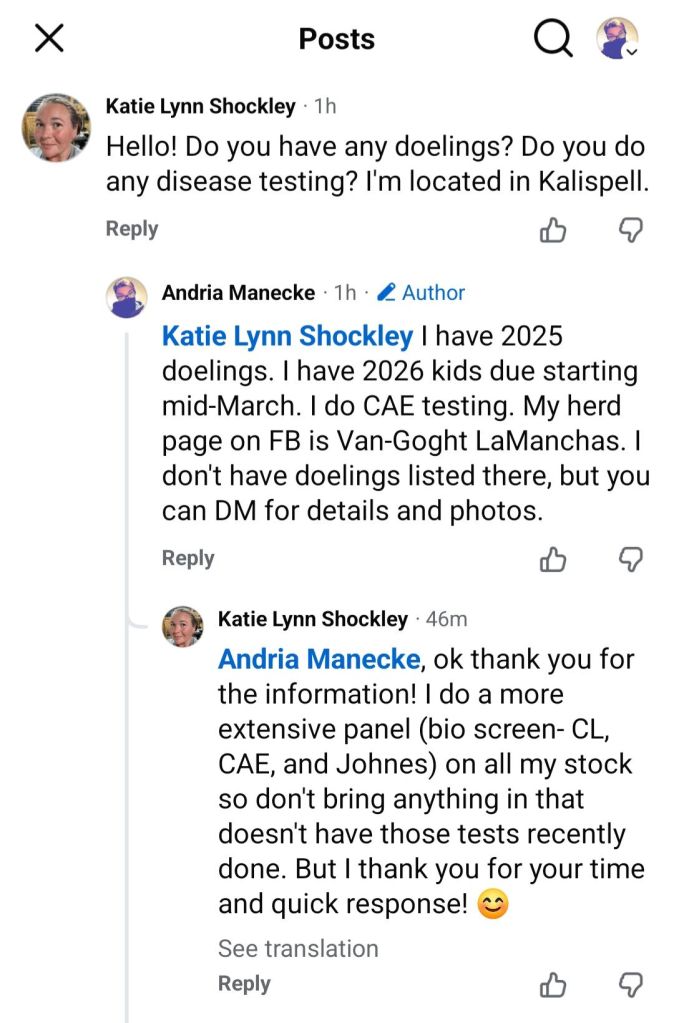
What would I do differently now, upon unloading a group of goats with CL lesions? (I can’t honestly say I’d test first. I routinely take people’s word for it, trust whatever paperwork they provide, and test later. I rely on their reputations. But these days, I only buy from people I know. It is what it is. I like to think I have more discernment, at least.)
What I would almost certainly do now is load those goats back up and take them back to the seller. I wouldn’t ask first. And I wouldn’t ask for my money back. I’d accept responsibility, but I’d insist this was their problem, not mine. I wasn’t much more than a kid myself when this happened to me. I had a baby at home. It was the middle of winter, the roads were trash, and I had responsibilities at home. I was also pretty timid. I’m not now.
If that didn’t pan out, I’d go public on Facebook’s goat pages, not to out them, but to see if anyone wanted the goats, for free, and I’d provide free delivery. There are plenty of commercial market herds who have chosen to live with and manage CL. (At least that’s what they tell me. I don’t know of any personally, but I’d sure ask.) I didn’t have Facebook then. I wasn’t an option.
If that failed, they’d go to PAYs now. I don’t know if it would’ve been an option then. What fate is worse? The humane euthanasia I provided while I held their heads and cried? Or the sales ring? I don’t know. Maybe I did the right thing. But it didn’t feel right. I just know, after all these years, I still cry over it.
If I hadn’t already had goats at the time, maybe I’d have chosen to live with it. To not raise goats at all. To let them have their lives, and live them out. Maybe I should’ve sold the other goats instead. I don’t know.
I want to talk about the group of CL-positive goats I bought. The year would’ve been, probably, 2005. I did not have LaManchas at the time. I had purchased three purebred Alpine does from a seller dispersing a herd. I hadn’t had goats in several years, but my daughter was getting old enough that I thought she would like raising goat kids.
At the time, I had some other livestock advertised for sale, and someone reached out asking to trade a group of goats for one of the animals I had. They wanted the animal as a Christmas present for a child, but had no money to pay for it. I was concerned that they wouldn’t be able to care for the animal if they couldn’t afford the purchase price, so I offered to just buy their group of goats. They would have money for a Christmas present for their kid (hopefully a present that didn’t eat or require upkeep), and the goats would fit in well in my new little herd. They had very good pedigrees, and had been bred by a then well-known herd (that no longer exists).
I asked about CAE and CL status, and was assured they were tested and clean. I didn’t ask for proof. I had them delivered to me, sight unseen. Yes, I made every mistake. I thought I saw an opportunity to do something to help a family out, to help some goats out, to help my fledging herd out. Some part of me thought the universe wanted this for me.
I noticed the abscesses and swollen glands when the goats were unloaded. They never set foot in my barn. There was a buck, an open doe, a bred doe. I put them in a horse trailer. I had vet out immediately, tested, and got the worst news I could’ve gotten under the circumstances, and just in time for Christmas. All symptomatic, and all very CL positive. It’s an absolutely sickening feeling.
I reached back out to the former owners, who denied all knowledge of the infections. I asked them if they would be willing to keep my money, and take the goats back. I would ship them back at my expense. They said no.
I had my vet euthanize the open doe, and the buck. I didn’t know what else to do. I might do it differently now. But I just couldn’t have that disease on my property, or in my herd. On some level, I hate that I had it in me to make that choice, and to do that to them.
It got worse, though. I quarantined that bred doe in that trailer until she went into labor. Of course, I was careful not to cross-contaminate, but I spent time with her and got attached to her. I did want to try to keep her kids, raise them, test them when they were old enough. Get something good out of that heartbreakingly bad situation.
I’d kidded out a lot of does by this time, and was fairly good at recognizing and fixing dystocias. But I missed this one. The doe passed her mucus plug, and was uncomfortable, but not in active labor, never pawing, never down and pushing, for about 24 hours. I checked her every hour, then sat with her, watching. Finally I washed up and put a hand in her. The kid was backwards and upside-down, and stuck-stuck behind her pelvis. And he was dead. And I had my vet come out and euthanize that poor doe, still in the trailer, next to that dead kid. And I hate myself for it. And I wouldn’t do that again. But I was so cocksure it was the only answer. I held her while she died.
Honestly, it was probably the right answer. I don’t know.
I did ask questions, then. Discreetly. And people responded. Discreetly. I was told in whispers that the original breeder’s herd was known to be riddled with CL. It was a poorly kept secret, but a secret kept well enough that I walked into it, unsuspecting, trying to do a good thing, and thinking I was getting a good thing in return. I can’t even be angry.
Apparently the gist of it was, they believed if it ran rampant through their herd, the goats would get it, get over it, get immunity, no big deal. Except it doesn’t quite work that way. It would’ve made no sense to introduce those goats to my existing herd, and let to it run through my goats too.
I think about those goats a lot. I still won’t have CL on my property. Abscesses have other causes too, and goats do get them, but any time I see anything looking like the start of one, we isolate, lance, test, retest. And every time, I’m sick to my stomach with worry until the negative results come back.
When this happened, I tested my other, unexposed goats just to be safe. Then again four weeks later. Then at six months. Then at a year. They stayed negative.
You look at losses like that, and try to find the lesson. What did I learn? What lives did I save later? What made their sacrifice worth it?
I’m kind of in a place now where I think the shitty things just happen. The universe isn’t out to get you, nor is it trying to make you wise. I’ve carried this experience forward, tried to apply what it taught me. I do check cervixes sooner now. I’ve fixed dystocias now I’d have missed back then. I spot those upside-down-and-backwards kids and I so enjoy the satisfaction I get sorting and delivering them alive. But maybe the point wasn’t any of that. Maybe it was just a big cluster fuck of a tragedy from the jump, and I made it worse. Or just, maybe I made it one.
I defend a lot of people pretty ferociously when I see them getting dragged for what other people perceive to be poor choices. There has to be some grace, some forgiveness, some understanding for those people whose choices have these outcomes. I think we’re all trying to do the best we can, with varying degrees of luck and success.
I’m going to be really transparent here: When I named this blog, THIS type of interaction is the one that ticked me off the most. It’s also the one that fascinates me the most, and I have every intention of doing an educational deep dive on the topic. But not today.
I sold a doe to a small breeder in another state a while back. They had her for a while, but in the long run she wasn’t a good fit. They told me, I offered to take her back, and they offered to breed her to their really well-bred buck before she was returned. I agreed.
The buck was CAE-positive. The small breeder was upfront with me about it. I’ve owned dairy goats since the late 1980s. I was aware of CAE and CAE prevention protocols when they were in their infancy. I wasn’t worried.
I got worried, though, when the doe injured a leg and came up lame; I’m human, and I assumed the worst. (I was vindicated later, as was the small breeder, but that doesn’t make the short-term panic easier to digest.)
This is sort of that “Do we vaccinate our baby or not?” argument. My unvaxxed human child is much healthier than my vaxxed human child, but the panic I felt every time the unvaxxed kid got a fever growing up was unparalleled. (Well, until the vaxxed one was diagnosed with cancer. But that’s a story for another day. Spoiler: She didn’t have cancer.)
(You: “How is that the same?!” Me: I took a known risk because I didn’t think it was a *big* risk, based on a lifetime of goat ownership and everything I knew about the topic. It worked out for me. YMMV.)
I tested the doe before she kidded. Negative. I tested her a year later. Negative. I tested her two years out. Negative. I tested her kids at a year of age. Negative. I tested them again at two, prior to kidding. Negative.
So where does the mansplaining come in? The original breeder of the buck who had tested CAE-positive reached out to me, told me he knew the buck was positive, and “pretty much” (reading between the lines) told me to cull the doe and the kids–and he absolutely roasted the small breeder at the same time. It’s not that hard to be nice. And the world isn’t black and white. Even when it comes to CAE, a communicable, and in some states, reportable, “terminal” disease. (Hang in there; I’m on your side. I sure don’t want CAE-positive goats, either…but this is NOT as cut-and-dried as everybody thinks.)
I am not advocating for using CAE positive breeding stock. But sometimes really bad things happen to really good goats and really good people. And there are known protocols in place to address this. It isn’t an automatic death sentence. It IS a lot of added labor, and a lot of added worry. But again, as I tried to say in previous posts on other topics, if you love the animal in front of you, you have options. You don’t have to listen to the first person who tells you to cull this or sell that.
(Before you go misinterpreting me and starting rumors, I want to state clearly I don’t have CAE positive goats. I do have life experiences I want to share after 40+ years owning dairy goats, and you can interpret them however you wish. At this point in my life, I really don’t care what you think of me.)
I have a yearling due in April. She is the granddaughter of the doe who was returned to me bred to a CAE+ buck. She’s the only doe kid I have who carries those bloodlines from that buck, the buck whose breeder basically berated me for taking on this experiment. The bloodlines matter to me for sentimental reasons. The breeder matters to me, because I kinda like the guy, and I like that he doesn’t much like me. I’m going prove him wrong here, when that doe freshens, is lovely, and doesn’t have CAE. It was a gamble, but honestly not much of one, and worth it.
(Someone out there is going to say those negative tests mean nothing, I was stupid, and buyers should avoid me. It’s okay. You are not my target market. There are boutique breeders out there doing everything right; please support them. No hard feelings.)
Yeah, the Facebook post I started this with is about everything *but* CAE, and I’m going to get there. For now, I’m going to publish what I have, and come back with a Part II. I have CAE stories. I have CL stories. And I have opinions on testing or not testing, frequency of testing, cost of testing, and so on and so forth. Check back. Thanks for reading.
Oh, wait, no…that’s not where I was going with this.
I’ve seen a topic shared a whole lot on Facebook lately. Now, maybe it’s just because I clicked on one post and read it, and the algorithm works in such a way that I’m being fed more of a topic that interests me. Or maybe there’s a lot more people out there experiencing this than usual. Either way, I’m seeing a lot of ignorance and misinformation about a subject I know a little bit about.
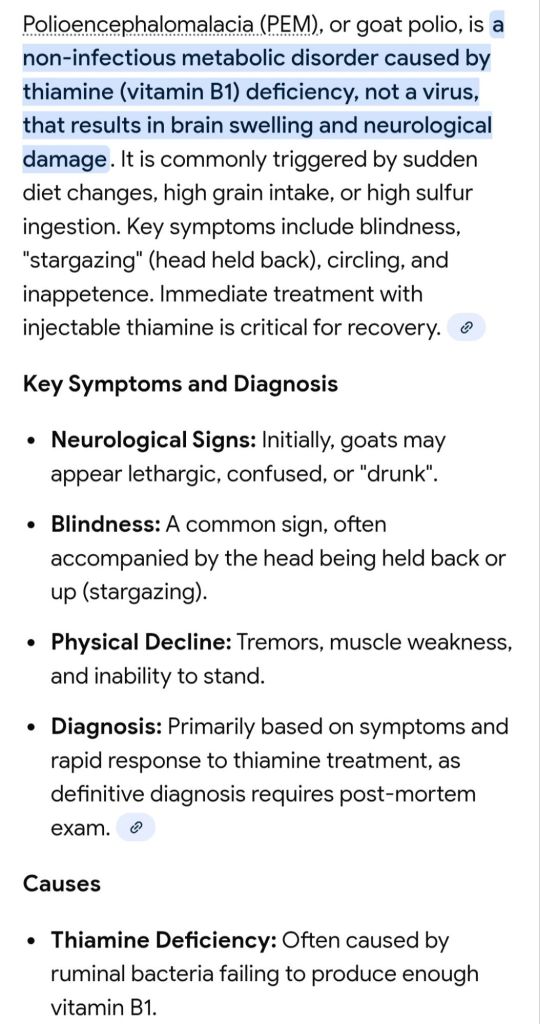
The topic: Goat polio.
This is not a medical blog. I am not qualified to speak on medical issues. I am not an educator. Always consult a vet! Don’t listen to suggestions from randos on the Internets!
With that out of the way, the thing that keeps getting on my nerves is this: I keep reading posts that start, “My goat has polio!” No. Your goat does not have polio. Your goat has “goat polio.” This terminology matters.
Second annoyance? The comments. Inevitably, someone chimes in with, “That is so contagious! You need to separate that goat! You will lose your whole herd!”
Someone else–understanding at least that “goat polio” is not poliovirus–will impress upon you the need to immediately treat every animal in your herd for thiamine deficiency.
And finally, someone will attack your husbandry top-down and tell you every thing you did wrong and how to fix it (but not before making you feel really, really bad about it).
(Disclaimer: There are other diseases that can present with symptoms similar to those of goat polio. Listeria comes to mind. I’ve never seen a case, I don’t know much about it, I don’t know how contagious it is. There are things that can put your whole herd at risk. I want to put your mind at ease about goat polio here, but I don’t want to overlook the fact there are things that look like goat polio, that might require more worry.)
The first case of goat polio I ever saw was in a fancy little black sundgau LaMancha kid I’d purchased to improve my herd. At the time, she had the best pedigree of any goat I’d ever owned, and I was so pleased to have her.
Her breeder delivered her when she was around six weeks old, and still on a bottle. When she arrived, she had diarrhea. The breeder chalked it up to the very nice alfalfa she’d recently started eating, combined with the stress of transportation. Likely an accurate reason. I was worried, though, and took her to my vet. She felt good, no fever, eating well, hydrated. Vet wasn’t worried.
The next day, she started having seizures. I rushed her back to the vet, she died, and he sent her to the State lab. Diagnosis? Goat polio. I panicked, felt instant despair for my whole herd, kicked myself for bringing in outside goats and exposing mine…in other words, did the same thing everybody does the first time they hear the words “goat polio.”
Then the vet explained this was a vitamin deficiency, not a virus…and I did the next thing everybody does when they learn about goat polio by experiencing it: I treated every goat in my herd with thiamine, and beat myself up for getting things so wrong with my feeding program.
In hindsight, I know my herd didn’t need thiamine injections, and you (pretty much) can’t feed in such a way a whole herd would get goat polio. (I mean, never say never, but.)
(Now, there are imbalances and deficiencies that can be caused by what we feed or don’t feed, and goats are susceptible. A balanced feeding program is important for a multitude of reasons, especially for bred does, lactating does, and growing kids. In fact it’s the most important component, I would say. But getting it wrong in little ways isn’t apt to be the reason you had to treat a case of goat polio.)
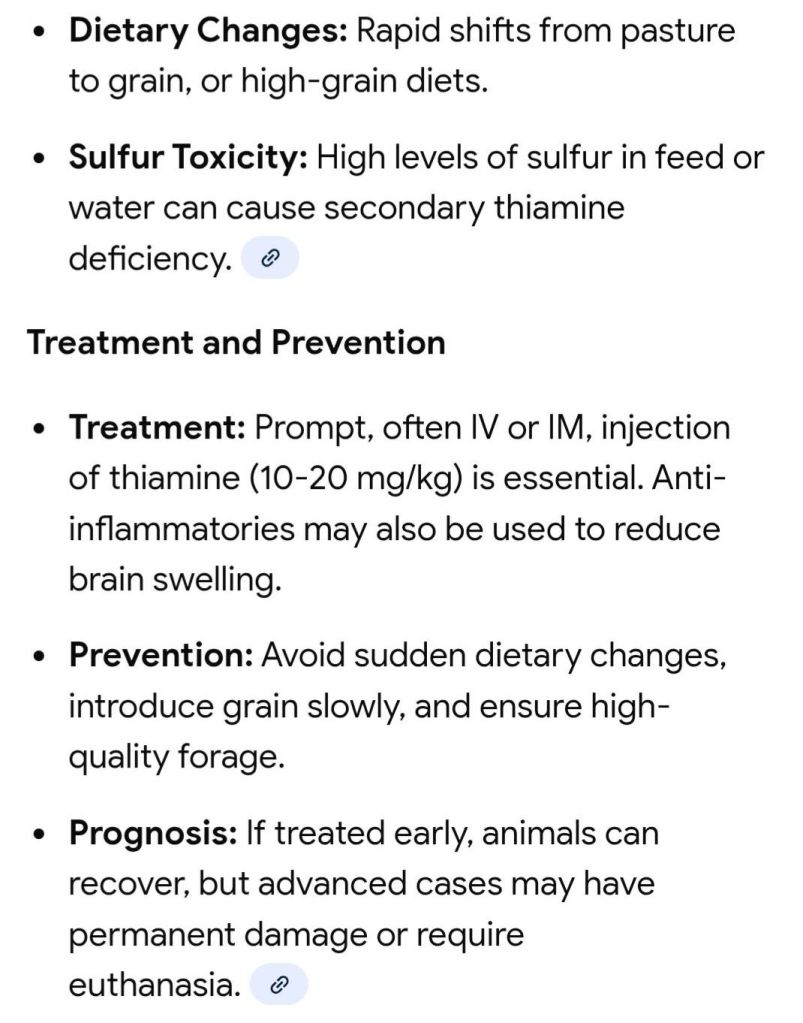
I don’t blame the breeder. He did nothing wrong. If I had it to do over, I might take away the alfalfa, and I might switch to a pectin-based electrolyte solution for a day or two, until the diarrhea stopped. I probably would treat with thiamine as a precaution. In most cases, it is safe and can’t hurt. In fact, I do that now any time I have a sick or stressed goat. (Not a recommendation. I’m not a vet.)
Now, to the husbandry part. If you have goats, sooner or later you will see goat polio. It probably won’t be because of something you could’ve prevented. Laypeople are going to blame you. (Exhibit A, internet comments from strangers.) You’re probably going to blame you. You’re going to feel bad.
This might make you feel better: Goats produce their own thiamine in their rumen. If something disrupts the gut, it can deplete and interfere with that production of thiamine. (This is a simple explanation, but I think a good and “accuate enough” one.) Lots of things can disrupt the gut. Feed changes. Stress, ranging from stormy weather to transportation to that one aggressive doe giving a side eye. Cold. Heat. Wet. Wind. Viruses. Parasites. Antiparasitics.
You can control for some of that. You can’t control for a lot of that. Feed changes are inevitable. Do it slowly, be watchful, but if you make a change and have a problem, accept it’s part and parcel for having goats.
Treating for parasites is both a necessity, and an art (and a whole ‘nother topic, and one that varies widely depending on lots of variables). And it can be a trigger for goat polio. But so can *not* treating for parasites. So ya gotta do it. (Or not, I guess. I have worked with people who didn’t treat for parasites, and people who only treated through natural means. I might touch on that in another post. No judgement.) Be mindful and watch extra on those days. Sick goats? Look for symptoms. Don’t be afraid to (ask your vet if it’s alright to) treat early, to treat on a hunch, to treat prophylactically.
(No, I don’t generally ask my vet before I administer thiamine. I just feel the need to tell you that you should. And I feel the need to tell you that a lot. Not because I think you’re an idiot who needs the oversight of a vet in all situations, but because I might be an idiot in some situations, and you should listen to professionals, not me. That’s all I’m saying.)
I’ve seen two cases of goat polio in bred does. One presented with diarrhea, followed by general weakness, and progressed to an inability to stand. She was treated with thiamine and dexamethasone and recovered, but aborted (a known risk, common when using dex). It became apparent soon after, that she had become blind. Most of her vision returned over time. In her case, I had been out of town earlier, and would venture to guess the person doing chores gave her too much grain. I don’t know for sure, though.
The second doe had been fine at evening chores, was down and couldn’t stand the next morning, and was bending her head over her back in obvious discomfort. I treated her promptly and she recovered completely. She was one of a group of about 16 does, all receiving the same care. It was a pretty random thing. I can’t recall whether she aborted. It seems like a memory that would stick in my mind, so it’s possible she didn’t. It’s also possible I didn’t use dex to treat her. I don’t remember, and didn’t keep notes.
(Random aside, it might be helpful to keep a notebook as you go, and to write down things like this. Keep track of illnesses, symptoms, medications, dosages, outcomes. It would be great to have that information handy to refer back to later. There are some really good and comprehensive goat sites on the Internet, and I find myself Googling and revisiting them for information on medications, and for dosages, but it would be smarter and more convenient to just write it down and keep it.)
I do know of one pregnant doe belonging to another breeder who was treated with dex and held onto her pregnancy, so that can happen. You’ll have to weigh your options if you find yourself in a similar situation.
A friend called me in a panic one evening because her goat was standing stretched out and screaming in pain. We rushed out to see if we could help. My brain didn’t jump to goat polio. The combination of standing stretched out and crying made me think a clostridial infection might be a possibility. The cries increased in volume and intensity, and we rushed the goat to the vet. His screams were very distinct, and I’ll recognize them next time–encephalopathic cries. The vet knew immediately, and started treatment. I hadn’t seen that as a symptom before and didn’t consider it. He did recover completely.
My most recent goat polio case was in my favorite little 2025 commercial buck kid, Tom, who I’d retained to use on my dry yearlings. (Yes, they’re LaManchas. Yes, he’s a meat goat. We can talk about it another day.)
Tom, and his brother, Bert, were living in a pen together, just the two, to keep them separate from the 2025 doelings to avoid accidental matings. There had been no recent dietary changes or stressors, and both were chunky and lovely and healthy and happy. Then I moved Tom away from Bert and into a pen with a couple does. Bert took the change in stride. Tom handled it by having seizures. Full-blown, flat-out, whole-body seizures lasting seemingly an eternity.
Tom had been fine the night before. He liked his new ladies. They liked him. In fact, he seemed fine that morning when I started feeding. He was bouncing around in his pen. I led a doe in heat past him, and he talked to her in typical buck-speak. I put the doe where she needed to go (in with a different buck), turned around, and Tom was down.
I didn’t think goat polio at first. In fact, as I watched him coming back around and trying to get to his feet, I started researching on my phone whether meat goat breeds might carry genes relating to seizure disorders. It didn’t click for me until I went into the pen, intending to catch him and move him to a stall, and I realized he was completely blind.
Tom responded quickly to treatment. It seems his vision has at least partially returned. He did breed his does, and it seems they’ve settled. (I don’t generally blood test or ultrasound. I go by gut. Personal choice, works for my herd. Neither here nor there.) I am very relieved he’s okay. And his brother, Bert, is thrilled…because he got to go out with the yearling does instead of Tom.
Anyway. I just thought it might be useful to share my first-hand experience, in case a few greener goat owners need some reassurance and some help cutting through the misinformation in the comments section on Facebook on posts about goat polio.
Of course I don’t know everything there is to know (as with everything else in life, the more you know, the more you realize just how much you don’t know), and I’m sure this disease and others will continue to humble me as I go. I do have enough knowledge now to recognize it and to treat it, and to know it’s probably not my fault when I see it. I want that for you, too. Add it to the differential when faced with a sick goat. Act promptly, but don’t panic, and don’t get sucked into the blame game. You’ve got this.
***
I don’t know if this stuff is useful. I don’t really have a framework in mind going forward. I like to write, I kinda like to vent, I have a particular dry sense of humor that feels insulting and occasionally costs me friendships, and I’ll probably keep dumping thoughts here as I have them. I’m choosing to free write, and to not go back and edit or rewrite. So some of this may be cumbersome or nonsensical. (I do have a writing degree. I do also take liberties with grammar and punctuation, because someone told me once, once you know the rules, you can break them. I used to know the rules, but now I’ve forgotten them. So.) I hope you don’t judge me too harshly. Thank you for reading.
If my previous post came off as naive, that wasn’t my intention. I’ve spent a lifetime in purebred livestock breeding circles, and I believe, as everyone should, that your goal should be to leave the gene pool better than you found it. Be a breed ambassador. Pursue the standard. Seek perfection.
Just don’t look down your nose at people starting out, people crossbreeding, people choosing grade stock over papers, people who can provide good and loving homes who lead with their heart over logic, people with modest goals…there are breed ambassadors and people who change the game…and there is everyone else. It’s okay to be everyone else.
I mentioned in an earlier post that I was there at the very beginning when Nigerian Dwarves first became commercially available in the United States, and when mini LaManchas were developed. I saw them then, and I rediscovered them years later after selling my goats to go to college, after starting a career, after getting married and having a family…and the goats I left behind are not the goats that exist today.
I am blown away in the best way by the quality of Nigerian Dwarves and mini LaManchas on the market today. If you weren’t there at the beginning, you wouldn’t understand. And that improvement, that forward progress, is thanks to dedicated breeders, calculated selection, aggressive culling, and time. Breed ambassadors pursuing a standard.
I saw a Facebook post today that was beautifully written and that perfectly illustrated the importance of having a breed standard, and breeding towards it. I didn’t screenshot it, and I probably can’t find it again. And I don’t want to steal their ideas without giving them credit. But if I can find it again, I will share it. It does matter.
But what I want to say is that there is value in starting where you are, enjoying what you have, and appreciating the journey. You can love the goat in front of you in spite of their flaws. Perfection does not exist.
I donated a handful of registered does and kids to a 4-Her new to a dairy goat breeding project once. My daughters had moved on to high school sports, and, with the best of intentions, I tried to pass their project–and all of the joy and satisfaction it had given us–on to someone else.
Some of the kids were squirrelly. My daughters had lost interest by that last year. But I’ve never had a squirrelly kid who didn’t settle down with regular handling. And part of 4-H is putting in the time. I thought a 4-Her starting out would do the work and get the satisfaction of gentling and training an animal. Trouble was, that squirrelly behavior became a reason to cull rather than do the work.
And they weren’t show stoppers. But they were a solid base to improve upon. The best lesson I learned from the 4-H dairy goat breeding project–which I participated in from 1986 to 1991–is that improvement is possible with every generation, and it happens quickly, because goats can be bred the year they’re born. It is deeply satisfying to watch that evolution.
I thought I did a nice thing, a good thing, giving a young breeder a start with registered stock sporting decent pedigrees. I didn’t. I did those goats a disservice. I regret it. But I can’t undo it. I wish that person had had the same vision I had, and that my gift to her had worked out the way I thought it would. It didn’t, and I have to live with that.
And with that in mind, maybe I’m wrong about everything.
Except I’m not. People love goats because goats are awesome. The ones at the petting zoo are awesome. The ones at goat yoga are awesome. The ones eating the weeds outside Amazon headquarters that get on the news are awesome. There’s the folks who breed for meat, those who breed for milk, those who breed to show…and people who just like goats and care for them well. There’s room for everybody.
 Quit Mansplaining Raising Dairy Goats To Me: A Blog