It’s been a while. I’ve been hybernating. Now might be a good time to mention the fact I’m a lifelong sufferer of S.A.D. I’m kind of a pro. I manage it well, though. (By well, I mean, look!, I’m still alive.) Mortified by my casual ketamine admission earlier? I did it professionally, under the guidance of a psychiatrist and a therapist. Did it cure me? No. It was a good time, though.
(Happy to answer questions; don’t hesitate to ask. I’ve done the psychiatrist thing, I’ve gone the integrated health route, I’ve done the therapy thing, I’m well-versed in the over-the-counter supplements, the essential oils, the grey market peptides, the happy light, and the cold plunging. What works? Winter ending. Anyhoo.)
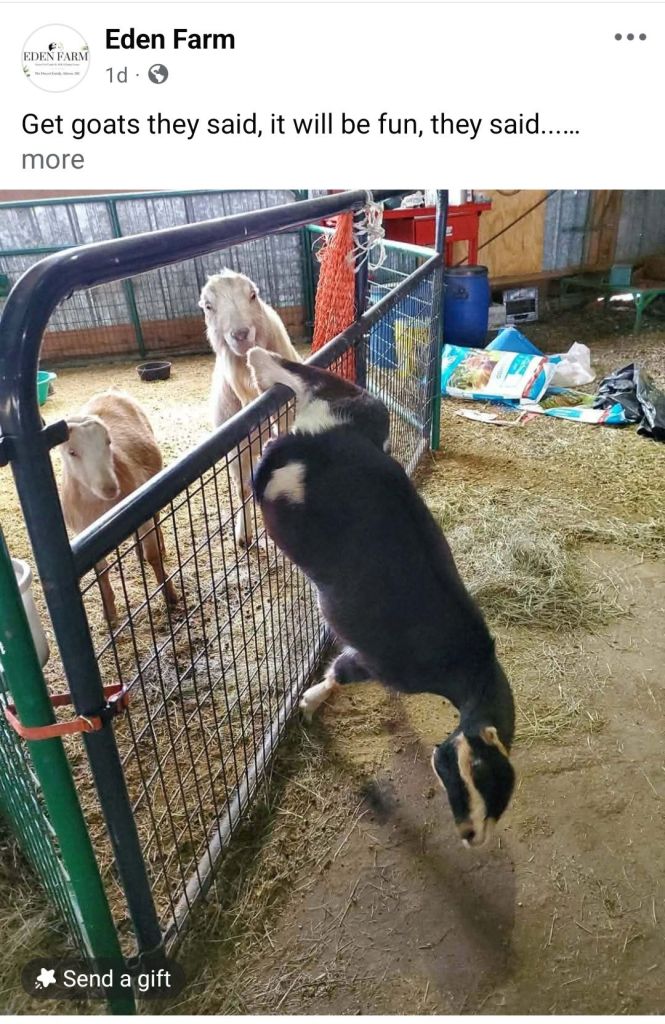
Here’s another Facebook post from another farm I don’t know. Credit to them.
I want to make it clear I am not judging. I just really feel this photo viserally. And it is a good illustration of something timely, because this is the part two of my first aid thoughts, and this photo confirms, “Everything that can go wrong, will, in spite of the best of intentions.”
This is fantastic, safe fencing. Until it isn’t. It is very similar to the fencing I have. And it is a blessing (great for baby kids!), and the bane of my existence. It is the most common cause of the most common injury I see in goats. That injury is broken legs.
Something about injured and broken legs is kind of exciting to me, because it is such an awful thing, that is so often really fixable. Your immediate reaction will be, “This is devastating!” But take a deep breath. It isn’t, always. It’s amazing what will heal. I’m a fixer, and broken legs are usually something that can be fixed.
I once had a yearling doe catch a foot in the fence while jumping over a 4′ horse panel*, and dislocate her leg at the hock…360 degrees. Guess what? She recovered. And she went on to carry kids. My vet cast the leg, we waited eight agonizing weeks, and afterwards, she had a stiff leg and a funny gait…but she lived a full life. Amazing.
If the break is between two joints that can be stabilized with a cast or split, that break will heal. If it’s at the fetlock or knee or hock, but the skin hasn’t been broken, it’s well worth casting or splinting. Soundness isn’t guaranteed, but it’s likely that goat will have a good quality of life once healed.
I haven’t had a break so high in a hind limb that it couldn’t be stabilized in a goat, so I can’t comment about that. I tried to save a calf with that sort of break, unsuccessfully. My vet did advise against it, and was right.
I did have a shoulder break in a goat kid that got butted, and simple confinement was enough…the kid recovered and could walk normally at weaning. (My vet said it couldn’t be cast, which sounds accurate.) Initially, the kid was dragging a limp leg. He would rest it on flakes of hay while he ate. In time, he started putting weight on it. I wasn’t optimistic, but I was pleasantly surprised. So there is hope for those injuries.
When it comes to compound breaks, injuries with exposed bone, my vet won’t cast those, and recommends euthanasia. That is the choice we made when faced with one this spring. It’s an awfully rare injury, and it’s unlikely you’ll ever see one.
I was once asked to take a young kid to try to save it after it sustained three broken legs. Yes, three. We had all three legs cast, and tried our best, but when the casts were removed, the bones hadn’t set. We euthanized that kid. In hindsight I have to wonder whether a kid who broke three legs simultaneously under normal living conditions didn’t have a genetic condition. It didn’t occur to me at the time.
*I wanted to mention, my goats aren’t generally jumpers. My fences range from 4′ to 4’6″, in special cases 5′, and it is so incredibly rare to ever have one jump out. I only have two stories of goats who routinely jumped over fences, one being Elvis, the mini LaMancha buck–recently passed and greatly missed–who lived most of his life behind 5′ panels because he was a menace…um, I mean, a gifted athlete. His story is on my FB page, Van-Goght LaManchas.
The other was Absinthe, a gorgeous LaMancha buck who discovered he could jump mid-breeding season one fall, who then proceeded to jump his way across my property and into a pen of LaMancha does in heat–who had already been exposed to another buck. Later that year, Absinthe went to live with some goat breeders who happened to have elk fencing on their property. We do have several well-loved daughters retained, who continue to influence our breeding program. Thankfully the jumping gene wasn’t too dominant.
 Quit Mansplaining Raising Dairy Goats To Me: A Blog
Leave a comment