• Scott Adams died today. I have a goat named Bigly–after Trump’s use of the word–and after Scott Adams’ book, Win Bigly.

    Three-time Trump voter. (Don’t let the door hit you on the ass on the way out. And this isn’t an airport…you know the rest.) And I have loved Scott Adams since I read my first Dilbert cartoon. I’m kind of a wreck today. But then, I’m kind of a wreck every day. I keep failing, but I imagine it’s not too late to get something right. I didn’t always get everything wrong. I’ve just been in slump.
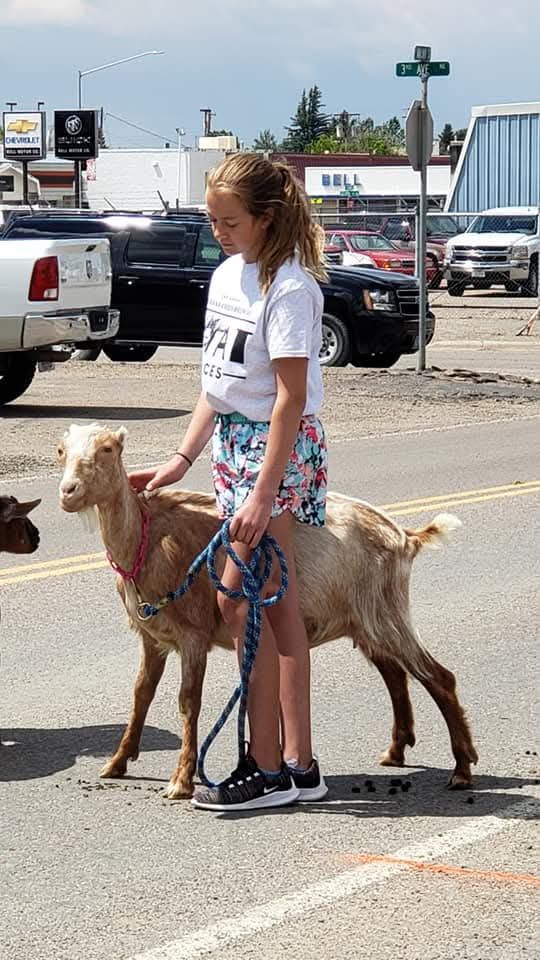
    The inspiration for this blog entry is a Facebook post I saw written by a “big breeder,” someone known in the ADGA goat show world. They’re so well known that I can’t remember who they are, and I didn’t screenshot or save the post. But, as always, all credit to them. And being as they’re a bigger breeder, I imagine some of you will recognize the post I’m about to address. So be it.

    Anyway, I read a brag post on Facebook, a virtue-signalling bit of slop, the gist of which was, “big name breeder” took a promising youngster to the National Show, youngster placed, applause all around…and they brought her home and put her in the freezer because she wasn’t correct enough for their program. Again, applause all around. Gag me. (The colloquial “gag me,” circa 1989. It probably means something else now.)

    I don’t care what you do with your goats. They are livestock. The law supports your choice, the industry supports your choice, and, like you, I want to have and keep the right to dispose of my excess, or sick or injured, or dying livestock however I choose, so, I, too support your choice.

    I’m just not going to give you accolades for putting a doe who placed at a National Show in the freezer. If you weren’t seeking validation and praise, you’d have just put the goat in the freezer without making a self-aggrandizing post about it.

    (I mean, yeah, that’s the path to get to and stay at the top, for sure. But the path and the top are something different for each of us. Your standard isn’t “the” standard. That’s all I’m trying to say. As a top breeder, you’re modelling behavior that others will copy. Maybe not every one of them should.)

    I hate the message you are trying to send. The message is a variation on that trite old chestnut, “It costs just as much to feed a poor quality animal as it does to feed a top quality animal.” And it’s true. And you’re right. But you’re doing all sorts of disservice to all sorts of people and all sorts of goats by sharing the message the way you share the message.

    And this where I note I’m going to struggle to explain what I mean, and you’re going to get defensive and dig in, and I will be wrong and you will be right, but with your standards, my Jazzy would be in the freezer under a goat with a ribbon from a National Show, and my Bigly would’ve been gone at weaning.
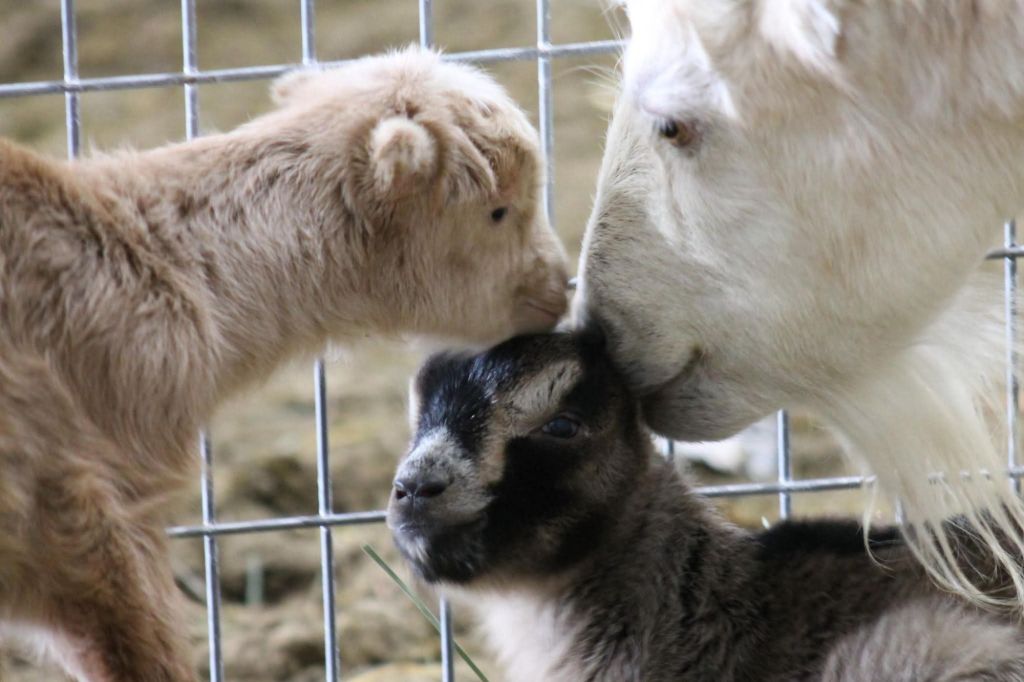
    Jazzy and Bigly and mom Dolce. Dolce’s still alive and living out her retirement here. She’s 13 this year. Dolce’s dam, Britney (as in Britney Spears), passed away at the age of 14, after also living out her retirement here.

    Reminds me of a second big post from another big breeder (again, credit to the poster, though this one is vague enough and common enough it won’t be recognizable, and again, I don’t remember who it was), who had a valuable doe become infertile after a difficult delivery. When the doe couldn’t reproduce again, they chose to euthanize her after harvesting eggs or embryos (I forget which, but embryos autocorrected to embroidery, and that feels worth noting).

    Modern reproductive technology is amazing and interesting, and I appreciated them sharing. There was a time when I lived and breathed reproductive technology, and the field has come so far since then. And no judgements for their decision to humanely euthanize an animal who could not longer earn her keep. That is ethical and wise.

    I have chosen, whenever possible, to give my older does a retirement home instead. That is what feels ethical and right to me. It isn’t wise. It is expensive and time-consuming. But they gave me all they had, and because of that, so long as I can, I owe it to them. And I can. We have 160 acres, and we can provide for them. And they are my friends.

    My Jazzy and my Bigly are nine years old this year. They will die here. They deserve that, for the joy they’ve brought into my life. They are amongst my favorites. The joy they’ve given me didn’t include a single blue ribbon, but one year Bigly placed second at the Cut Bank Creek Brewery goat races, and another year, Jazzy did. Those memories are priceless.

    Jazzy was the product of a heart project. I started my herd with Alpine does, and I bred them to LaMancha bucks. Dolce is a 50-50 doe. Jazzy is 75% LaMancha. She is beautiful. And she was born with four teats. I was devastated. I scoured the rule book, I had my vet remove the extra teats, I bred her, I held my breath…and Jazzy had a son with extra teats. I never bred her again.

    Jazzy does have a younger sister, Stevie. Stevie has two teats, and she gave me a registered daughter in 2025. And I’ll soldier on, with a chip on my shoulder and my heart on my sleeve, because these are the goats I gave my life to, and I love them. You’ll cry the same tears when you bury your National Champion that I will when I bury my second-place race goats. (And that day will come far too soon, because goats live tragically short lives.) If we get there, I’ll feel the same satisfaction with a fifth place ribbon in a grade class at the State Fair with my Alpine cross doe that you feel every time you get that letter in the mail formalizing a Permanent Champion.

    Which one of us got it right?
  • One thing I learned really early: Someone who will talk shit about someone else to you, will absolutely talk shit about you, to someone else.

    I like gossip. Like, I *really* like gossip. I like it when people tell me things I shouldn’t know…generally about people I also don’t know. I rarely believe it, but as the bullied kid in grade school who didn’t get included in anything ever, that shit feels all kinds of good (for all the wrong reasons).

    But it does go both ways. The worst things I ever heard about myself came out of the mouths of people who had never even met me, or who had met me but never had a conversation with me. You can form an opinion about any person for any reason. And I’m all for trusting your gut. But before you trash someone, or take someone else’s trash talk at face value, at least talk to them.

    What does this have to do with goats? Nothing. But every little world is the same. The horse world? Vicious. High school sports? Ridiculous. I think there’s a point early, where you stick your foot in something new, where everybody is welcoming, whether your interest is photography or muscle cars. It always gets ugly. I guess you have to love what you love and learn to let the negativity roll off your back. I’m still working on it.

  • I was so painfully shy growing up that I didn’t speak until the eighth grade. And I only spoke then because I was cast a part in a play and I got to be a character that wasn’t me.

    I didn’t discover the Internet until 1996, and I discovered it while attending one last discussion at the college library to get one last credit to complete my B.A. degree. (I was in the last typewriting class ever taught at Cut Bank High School, and I graduated from college having never “googled” a single term for a single paper.)

    The Internet was magic. Email was magic. Chatrooms were magic. The Internet gave a really self-effaced, introverted, pathologically quiet person a voice. Because of the Internet, I met people, made friends, got married, had a life. But I kind of wish we could go back.

    There will (probably) never again be a world without screens and phones and a 24/7 bombardment of information about all of the world, all of the time. It’s making us crazy and destroying us. But, I mean, I’m never going to pick up a landline and call somebody, so…

    This doesn’t have anything to do with goats. Not really. Just a general assessment of life over 30 years. Thirty years living with the Internet. I wonder what life would’ve looked like without it?

    (It goes without saying, but The Internet Is Made Of Cats. @rathergoodstuff on YouTube. I guess the good outweighs the bad.)

  • It’s been a while. I’ve been hybernating. Now might be a good time to mention the fact I’m a lifelong sufferer of S.A.D. I’m kind of a pro. I manage it well, though. (By well, I mean, look!, I’m still alive.) Mortified by my casual ketamine admission earlier? I did it professionally, under the guidance of a psychiatrist and a therapist. Did it cure me? No. It was a good time, though.

    (Happy to answer questions; don’t hesitate to ask. I’ve done the psychiatrist thing, I’ve gone the integrated health route, I’ve done the therapy thing, I’m well-versed in the over-the-counter supplements, the essential oils, the grey market peptides, the happy light, and the cold plunging. What works? Winter ending. Anyhoo.)

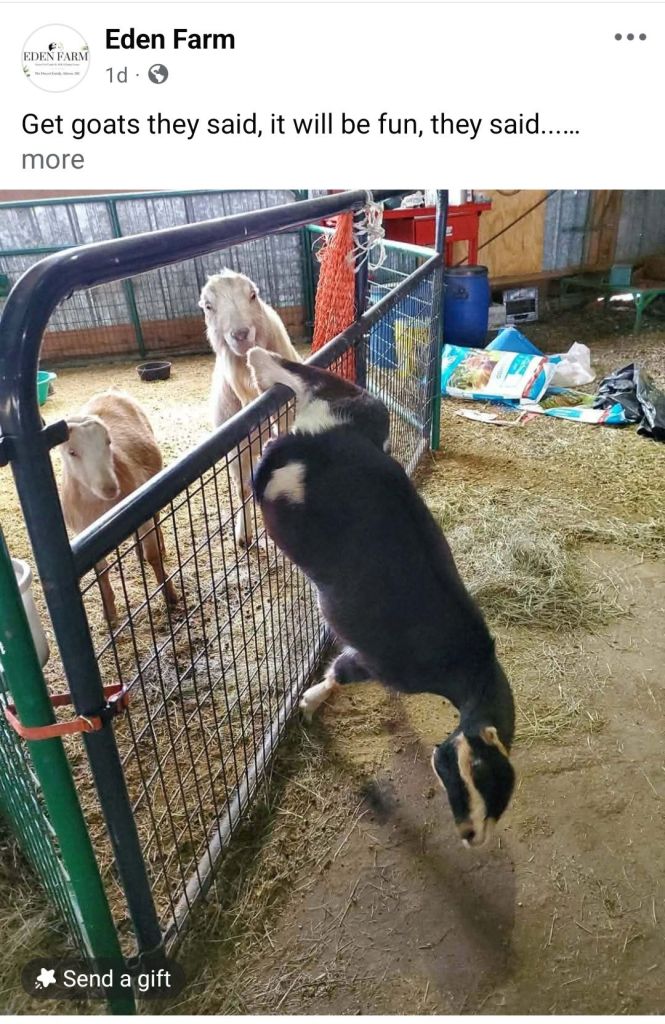
    Here’s another Facebook post from another farm I don’t know. Credit to them.

    I want to make it clear I am not judging. I just really feel this photo viserally. And it is a good illustration of something timely, because this is the part two of my first aid thoughts, and this photo confirms, “Everything that can go wrong, will, in spite of the best of intentions.”

    This is fantastic, safe fencing. Until it isn’t. It is very similar to the fencing I have. And it is a blessing (great for baby kids!), and the bane of my existence. It is the most common cause of the most common injury I see in goats. That injury is broken legs.

    Something about injured and broken legs is kind of exciting to me, because it is such an awful thing, that is so often really fixable. Your immediate reaction will be, “This is devastating!” But take a deep breath. It isn’t, always. It’s amazing what will heal. I’m a fixer, and broken legs are usually something that can be fixed.

    I once had a yearling doe catch a foot in the fence while jumping over a 4′ horse panel*, and dislocate her leg at the hock…360 degrees. Guess what? She recovered. And she went on to carry kids. My vet cast the leg, we waited eight agonizing weeks, and afterwards, she had a stiff leg and a funny gait…but she lived a full life. Amazing.

    If the break is between two joints that can be stabilized with a cast or split, that break will heal. If it’s at the fetlock or knee or hock, but the skin hasn’t been broken, it’s well worth casting or splinting. Soundness isn’t guaranteed, but it’s likely that goat will have a good quality of life once healed.

    I haven’t had a break so high in a hind limb that it couldn’t be stabilized in a goat, so I can’t comment about that. I tried to save a calf with that sort of break, unsuccessfully. My vet did advise against it, and was right.

    I did have a shoulder break in a goat kid that got butted, and simple confinement was enough…the kid recovered and could walk normally at weaning. (My vet said it couldn’t be cast, which sounds accurate.) Initially, the kid was dragging a limp leg. He would rest it on flakes of hay while he ate. In time, he started putting weight on it. I wasn’t optimistic, but I was pleasantly surprised. So there is hope for those injuries.

    When it comes to compound breaks, injuries with exposed bone, my vet won’t cast those, and recommends euthanasia. That is the choice we made when faced with one this spring. It’s an awfully rare injury, and it’s unlikely you’ll ever see one.

    I was once asked to take a young kid to try to save it after it sustained three broken legs. Yes, three. We had all three legs cast, and tried our best, but when the casts were removed, the bones hadn’t set. We euthanized that kid. In hindsight I have to wonder whether a kid who broke three legs simultaneously under normal living conditions didn’t have a genetic condition. It didn’t occur to me at the time.

    *I wanted to mention, my goats aren’t generally jumpers. My fences range from 4′ to 4’6″, in special cases 5′, and it is so incredibly rare to ever have one jump out. I only have two stories of goats who routinely jumped over fences, one being Elvis, the mini LaMancha buck–recently passed and greatly missed–who lived most of his life behind 5′ panels because he was a menace…um, I mean, a gifted athlete. His story is on my FB page, Van-Goght LaManchas.

    The other was Absinthe, a gorgeous LaMancha buck who discovered he could jump mid-breeding season one fall, who then proceeded to jump his way across my property and into a pen of LaMancha does in heat–who had already been exposed to another buck. Later that year, Absinthe went to live with some goat breeders who happened to have elk fencing on their property. We do have several well-loved daughters retained, who continue to influence our breeding program. Thankfully the jumping gene wasn’t too dominant.

  • I mentioned a few of the more common goat ailments in my last entry, but what about goat injuries? I’ve seen a few spectacular lacerations. But very few. I remember a goat slicing her side, top to bottom, and exposing her ribcage. My mom, a former vet tech, sewed it up when a vet couldn’t be reached. It healed with barely a scar.

    If you’re a do-it-yourselfer (most goat peeps are do-it-yourselfers), pick up some sterile suture packs, the kind with a needle and catgut (no, it’s not actual cat gut, at least according to Chat GPT), and some surgical scrub, and put it somewhere safe. It’s good to have some antibiotics and anti-inflammatories on hand, too, if you’re able to source them.

    Of course, use a vet if you have a vet, but you may find yourself in a situation where you need to deal with an emergency on a weekend when every local vet went to the same out-of-state convention. Or when you didn’t have the disposable income to justify the vet bill. (That’s okay.)

    In my experience, goat lacerations heal well, stitched or not. In spots you can wrap or tape, that’s an option, too. If you can’t do anything but keep it clean, that may well be enough. (I’m not a vet, and I can’t give advice. I’m just spitballing injuries I’ve seen and how I’ve handled them, in the hope it might be helpful to someone. Goats are fragile, but also really resilient. They’re an enigma.)

    This reminds me of another common type of injury. (And a story. Hang on.) Most dairy goats are disbudded. As those burns heal, scabs form and get knocked off during rough-and-tumble play, and it isn’t uncommon for some bleeding to occur. (It’s not particularly common, either, but disbud enough goats, and you’ll see some blood).

    If you have horned goats, horn injuries are less common, but they happen. Broken horns bleed like crazy. Here’s the thing, though. What looks like a life-threatening amount of bleeding, be it from a recently disbudded head, or a horn injury, usually isn’t. Blood stop powder may help. Pressure works better. Cauterizing with a disbudding iron often works. Most times, watching in horror until the blood clots works, too. Head wounds bleed a lot. Anyway, to my story.

    I know someone who bought a goat kid. Had it disbudded. (I didn’t disbud it. I wasn’t involved in any way, beyond hearing the story. So yeah, bit of an armchair quarterback sitch, but.) Brought it home. It started bleeding. This someone’s husband decided a mercy killing was the answer, because, “…there was so much blood!” and he was afraid the goat would bleed to death. So he killed it.

    That story makes me sick every time I think about it. And every time I disbud a kid for someone else, I tell it. And then I tell them all the ways to stop bleeding if it happens. And I advise that, worst-case scenario, bleeding out isn’t a terrible way to go. (Again, I’m in no position to give advice. Ask a vet, always. If there isn’t a vet to ask–and sometimes there isn’t–do your best. But don’t panic. You have time, even in the face of exposed ribs or copious amounts of blood.)

    I’m going to Part II this.

    Places to be, things to do.

  • I sell a lot of goats to first-time goat buyers. And written into my sales agreement is, “If you have a health question, ask.” But more importantly, “…if you lose a goat unexpectedly, reach out to me.” Believe me, I won’t have all the answers. But odds are, your vet won’t, either. If I can point you in the right direction, I will. And if I can help with your loss, I will. Just ask. Ask directly–tell me what you lost, and ask me how I can fix it–but please, ask.

    I was seven when we got our first goats, a white, horned nanny, and a white, horned billy. We named them Nanny and Billy. The first time Nanny kidded, her firstborn was stillborn. The second was alive. And that sums up raising goats. Forty-five years later, I walked out twice this year to newly delivered kids, where the firstborn was stillborn. It guts me every time. I try so hard to be present at every birth. Still, sometimes you miss them. I’ve been there, assisted, and still delivered stillborns. It happens. But when you miss it, you beat yourself up and you assume there was a problem you could’ve fixed, if only…so I try really hard to never miss a delivery.

    But if you have goats, you’re going to lose goats. I waver, when I sell newbies goats, between being giddy and excited for them, and being bluntly realistic with them. I tell them to go learn about things like urinary calculi and goat polio and clostridial infections and coccidiosis. If they’re breeding, I tell them to research toxemia and milk fevers and how best to sort dystocias.

    Goats have a steep learning curve. The bad stuff is going to happen, and you figure out what it is and how to deal with it in real time. If you’re lucky, you live close to a vet who knows something about goats. But you probably don’t. You figure this stuff out while burying the mistakes.

    I once had a doe collapse after delivery. In hindsight, probable ketosis. My vet (not my current vet) ran an i.v. bolus of calcium. She was dead in under 60 seconds. Milk fever was a good guess, but the wrong one. I find oral calcium supplements to be a more gentle and safer way to address the possibility now. I loved that doe.

    You need to learn at the onset, how to forgive yourself and move on when you get it wrong. And you’re going to have to accept, quickly, that you’re not really the one in charge here. With goats in particular, you can do every single thing right. In spite of that, there will come a day when you look over to see your favorite buck, who was eating his breakfast five minutes earlier, on the ground seizing. When he finally gets back onto his feet, it will become obvious he’s blind. Rapid, aggressive treatment will save him–and thankfully it wasn’t your first rodeo, and you knew what to do–but he may never regain full sight.

    Or you’ll walk out at seven a.m., in barely freezing temperatures, and your favorite doe kid will have done the impossible, caught her leg freakishly in the gap between her barn and her fence, and got stuck outside overnight…and because of the way her leg was trapped, blood flow was cut off to her foot, and you’ll have to euthanize her five days later. The vet won’t entertain the idea of an amputation, even though she was your best kid that year, and you were willing to pay. I miss you, Marta.

    If the squares in your fence are too big, that big oaf of a wether will get his head stuck, and if he doesn’t hang himself, you’ll for sure entertain the thought of killing him while you try to free him. If the squares are too small, that one adventurous but clumsy doe is going to catch a leg while trying to jump out, resulting in a repulsive compound fracture that can’t be cast, and your vet will agree when you decide the best course of action is to shoot her. (And yeah, at some point you might find yourself going to Google to figure out how best to humanely shoot a goat, because the vet is out of town, and because this degree of suffering can’t wait. Given enough time, you’ll get good at it. But it won’t ever get easier.)

    I’ve seen a lot of neat (and horrible) things. Early on, in the late ’80s, one of my LaMancha does developed hydrops during her pregnancy. She was closely monitored by a vet familiar with the condition, and she and her kids survived. Statistically speaking, I’ll never see that again. I have had one cloudburst (false) pregnancy. I wouldn’t have believed it was possible if I hadn’t been there “when her water broke.” She released a staggering amount of fluid…and no kids.

    I once had a kid born with an extra foot. That was cool. He went on to have a career as a weed eater for a conservation program. I’ve had two significant deformities, both dead at birth. One kid had a normal front end, but his back end was just a ball of tissue, and the hind legs were growing out of his back. He was delivered with two normal sisters who remain in my herd. The other was a massive kid with a spinal deformity and exposed brain that ended in an emergency c-section. The doe survived, and she lives in the retirement pasture. I wasn’t comfortable trying a v-back.

    In the case of random deformities, I don’t assume genetic anomalies, and I don’t automatically jump to pull them from my breeding program. I think sometimes things just go wrong. But of course if one doe were to have a repeat deformity, or if one bloodline exhibited the same, I would cull.

    I have had tiny, mummified kids delivered with term kids. Last year, I fished out handfuls of tiny bones from a doe who had a healthy kid and then kept pushing. The second kid had died at some point, and mostly dissolved. A couple years ago, a doe who had delivered a large set of triplets, and passed the placenta, spit out a tiny fourth kid two days later, deceased. I sure feel bad for missing that one, but it doesn’t make sense to go looking for lost kids in does who deliver normally and clean. (Yes, we treat these does with antibiotics and monitor; they have always settled again without issues.)

    This year, after 45 years, I got my first true hermaphrodite (terminology has changed over the years, and my education is old school, so pardon me if you feel a different description is better). This kid has female external genitalia, teats, and testicles. I don’t know what we’re going to do with her. Part of me is tempted to ask the vet about castrating her, but the realistic part says we should process and eat her. This is another one of these things I think is more random than genetic, but if you’re worried, just know she’s a meat goat, not a registered LaMancha.

    I did have live, healthy kids delivered 13 hours apart once. I wouldn’t have believed that was possible if I hadn’t seen it.

    Anyway, I’ve delivered a lot of kids, I’ve raised a lot of goats, and I’ve seen a lot of cool things. I know if you’ve had goats for any length of time, you have, too. There’s been a fair amount of loss along the way, and I suppose that’s the way it’s designed. Goats are the most fun you’re ever going to have. But probably the least, too. I guess it’s worth it.

  • This is another random Facebook post from someone I don’t know, but they did a great job of putting into words the reality that is goat ownership. All credit to them.

    It reminded me of a story. It’s funny, but it was also validating. I’ve had the same vet for many years now. What he doesn’t know about goats, he is willing to research. He’s seen me through many goat catastrophes, from broken legs that could–and broken legs that couldn’t–be set, to pneumonias, goat polios, toxemias, milk fevers, urinary calculi (including surgery), meningitis once, c-sections, …you name it. They’re goats. We’ve seen it.

    Anyway, a few years ago, he bought two of my wethers as pack goat projects. And later that fall, I got a phone call. I’m paraphrasing, but the gist was, “Hey, you’re right. Sometimes they just die.” Um, tragic, but…if you’ve owned goats for any length of time, you know. I felt bad, and I replaced the lost goat. But it is just a little funny…because if you have goats, you know that sometimes…

    They just die.

  • This was a post I saw on Facebook, from a herd I do not know. All credit to them for putting into words so well my exact philosophy. There isn’t one right way.

  • I think I was the first Nigerian Dwarf breeder in Montana. No, for real. There was a farm in Kalispell who used to advertise themselves that way. But I’m pretty sure I had my Dwarves before they did. We’re talking mid-80s. I have receipts…but they’re in a storage shed piled eyeball deep in the detritus of the last 45 years. So I won’t try to prove it to you, and I’ll settle for “one of the first.” Because I was. And that’s close enough.

    When I was in high school, I bought a breeding pair of Dwarves from what I think I recall was the Brush Creek herd in Washington. I may have that wrong. (I’m old, I like tequila, and I’ve dabbled in ketamine…I’ve done some brain damage. Topic for another day.)

    Their first kid was a buck I named Poco. He was born with a cyst on his neck. I had the vet remove it…risky, as it sat right over the jugular vein…and when he excised it, I could see the vein exposed and pulsating. After removal, the vet cut into the cyst, and it was lined with hair. Cool. He went to a breeding home.

    I don’t remember raising any other Nigerian Dwarf kids, although I’m sure I did. The other thing I did was to breed my ADGA registered LaMancha does to my AGS Dwarf buck (remember, in the 80s, the ADGA did not register Dwarves; mine had AGS papers). I sold these “mini LaMancha” crosses nationwide. Put them on Delta flights. The most memorable were a pair of black and white doelings who went to New York. If I wasn’t also the first person to raise mini LaManchas in Montana, I was darned close.

    I sold my Nigerian Dwarf doe when I went to college. Along with all of my LaManchas. My buck stayed, but he died of age-related causes before I moved back home. There was a period of time where I didn’t have goats. I did maintain my ADGA membership, though, because I didn’t want to lose my herdname.

    I mean, it’s a pretty funny herdname.

    A few years back, the ADGA awarded me a permanent membership, based on the number of consecutive years I’d been a member. I have a love-hate relationship with the registry, but that was quite an honor. I mean, it’s not based on show results or appraisal scores or pounds of milk…all I did was pay my dues…but for almost 40 years, I’ve been paying my dues.

  • I forgot, in the telling of my State Fair experience, one thing that made me laugh. The first day of the show ran incredibly long. I think everybody was worn out and over it hours before it ended. At one point, towards the end of the show, I looked up and saw one of my favorite exhibitors walking into the barn holding a beer garden beer. I cracked up. I have no idea what the barn rules are, or what etiquette dictates, but I have to say, a round of beer garden beers might’ve added some levity to an awfully tedious day. 

    After tucking our kids in that night, we got back to our hotel just as the in-hotel restaurant was closing. Yes, hotel…this was our vacation. I know the pros stay on the fairgrounds, but that requires a level of commitment I don’t have. We didn’t get beer garden beers, but I did get a bar-garita at a little hole in the wall we found open at that hour. And I got Starbucks the next day.

    The second day ran so long we bailed and went home before our kid classes ever started. But like I said before, they didn’t pull enough Grades to sanction anyway. No harm, no foul.

    This is the part where I want to say, I did show goats. For about six years, from the ages 14 to 19, we showed at the tricounty fair, the State Fair, the Billings fair, the Kalispell fair. Traveled. Stayed in a camper. Lived and breathed it. Won Herdsmanship trophies and Showmanship trophies, Best of Breeds, Best Udders, Best In Show. I know. I know what you chase. I know.

    Somewhere, I have an original, autographed copy of Harvey Considine’s Dairy Goat Judging Techniques. And at one time I had it memorized. (Go check out the value of that book on Amazon Marketprice, lol.) (I hope I have it somewhere; I sold used books for a summer after college, made $4,000 selling the contents of my high school bookshelves…I sure hope I didn’t sell that book.)

    I went to a National Show in Gillette, Wyo., just to watch the LaMancha classes. Humble brag, I had a private pilot fly me to the show that morning, and fly me home that night. I went to a National Convention in Spokane, Wash., and took a class on a.i.ing dairy goats when I was 16 years old (and then successfully a.i.ed goats…what I wouldn’t give to have some of that exact frozen semen back again). I watched the Spotlight Sale. I remember the glitter on the goats. They put glitter on the goats!

    Anyway. I know you mean well when you tell me what I could do better. Or what I should do instead. But I don’t want that. I just want the dopamine hit I get when I put my hands on a bred doe’s belly and feel kids moving. I want to relive the satisfaction I feel every time I see live and healthy kids nurse for the first time. (Yes, nurse. I’ve dam-raised, and I’ve pulled kids at birth, and I’m comfortable with both, and I’m aware of the arguments for and against either. I do the thing that works for the doe in front of me given the time I have available. There is not a right or wrong.) I want to keep being delighted when there are wattles. I want to see those 30-year-old names up close on my pedigrees, even though they aren’t trendy and they won’t place in the ring. (I do have 40-year-old frozen semen in a tank. Someday, I’ll use it.) And I want you to quit telling me how I’m getting it wrong.